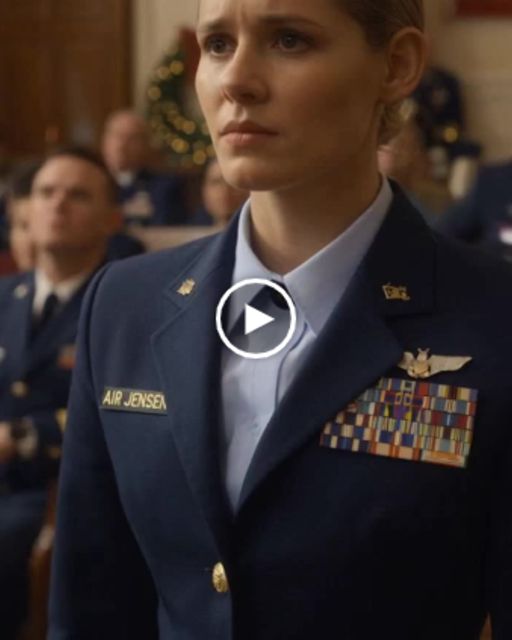
„SIT DOWN, CAPTAIN. YOU’RE NOT NEEDED HERE.” MY FATHER LAUGHED AT ME IN FRONT OF THE JOINT CHIEFS. THEN HE HEARD MY CALL SIGN.
I grew up saluting my father’s shadow. He was a General; I was his „disappointment.” To him, my career as an Air Force officer was just paperwork and logistics. He didn’t know about the selection courses I took during my leave. He didn’t know about the nights I wasn’t in my bunk.
We were in a high-level briefing at MacDill. Two hundred officers, mostly brass. My father sat in the front row, basking in his rank. I was in the back, trying to be invisible.
Midway through the intel report, the side doors slammed open.
A Navy SEAL Commander stormed in. He was wearing field gear, smelling of ozone and sweat. He didn’t salute.
„I need a precision marksman with Level 5 compartmented access,” the Commander shouted, scanning the sea of faces. „We have a hostage situation that requires a ghost.”
The room went dead silent. Nobody moved. Level 5 is above Top Secret.
I stood up.
My chair scraped loudly against the linoleum. Every head turned.
My father spun around, his face twisting into a scowl. „Sit down, Erik,” he snapped, loud enough for the back row to hear. „This is for the adults. Stop embarrassing me.”
A few Colonels chuckled. My father smirked, turning back to the front. „He pushes papers, Commander. He’s not needed here.”
The SEAL Commander didn’t laugh. He didn’t even look at the General. He walked straight up the aisle and stopped inches from my face.
„Call sign?” the Commander demanded.
I looked past him, locking eyes with my father. I kept my voice flat and cold.
„Ghost-Thirteen.”
The Commander immediately snapped to attention and handed me a secure folder.
The laughter died instantly. My father’s face went pale. He stood up, his hands shaking as he pointed at me. „That… that’s impossible,” he stammered. „Ghost-Thirteen is the operative who assassinated the…”
He stopped himself, realizing the classified nature of his words. His mouth hung open, a perfect circle of disbelief.
Commander Reed, the SEAL, didn’t wait for my father to compose himself. „With me, Captain,” he said, his tone now one of pure, unadulterated respect.
I gave him a short nod.
We walked out of that briefing room, leaving behind two hundred stunned officers and one shattered General. The heavy doors closed with a soft whoosh, cutting off the suffocating silence.
The hallway was cool and quiet. Reed didn’t speak until we reached a secure elevator, pressing his thumb to a biometric scanner.
„I’ve read your file, Thirteen,” he said as the elevator descended deep into the base. „The parts they let us see, anyway. I never thought I’d meet you.”
I just nodded again. There wasn’t much to say. My life was lived in the shadows, my existence a series of redacted lines in a file somewhere.
„Is that man really your father?” Reed asked, his curiosity getting the better of him.
„He is,” I said.
Reed shook his head slowly. „The world’s a strange place.”
The elevator opened into a cavernous hangar. A sleek, black, unmarked jet sat in the center, ground crew buzzing around it like bees. This wasn’t Air Force. This was something else entirely.
„Your gear is on board,” Reed said, leading me up the ramp. „We’ll brief you in the air. Time is not our friend.”
Inside, the jet was all business. A small team of four operators, all clad in sterile black gear, gave me curt nods. They knew the call sign. That was all they needed to know.
I stripped out of my pristine Air Force blues and into the matte black operational gear laid out for me. It felt like coming home. The familiar weight of the ceramic plates, the custom-fit holster, the perfectly balanced rifle.
Once we were airborne, hurtling across the Atlantic at supersonic speed, Reed laid a tablet on the table in front of me. A woman’s face appeared on the screen. She had tired eyes but a defiant set to her jaw.
„Anya Petrova,” Reed began. „CIA, deep cover. She was picked up two days ago in Belarus.”
He swiped the screen. A satellite image of a sprawling, derelict industrial complex appeared. It was isolated, surrounded by miles of dead forest.
„She’s being held here. By a man named Dimitri Volkov. Calls himself ‘The Serpent.’”
Another face appeared. This one was hard, scarred, with eyes that held a chilling emptiness.
„Ex-Spetsnaz. Dishonorably discharged. He now runs a private intelligence network, selling secrets to the highest bidder.”
The mission was simple, on paper. Get in, retrieve the asset, get out.
„Why me?” I asked, my voice low. „You have your own marksmen.”
Reed leaned forward. „Volkov’s facility has a new counter-surveillance system. State of the art. It creates a thermal and electronic bubble. Our drones are blind. Our satellites are useless.”
„There’s only one way in,” he continued. „A storm drain outlet, three hundred meters from the main building. The pipe is sixty centimeters in diameter.”
The other operators exchanged glances. A sixty-centimeter pipe was a crawl, not a walk.
„But the last twenty meters of the pipe are rigged,” Reed added, his face grim. „Pressure plates, acoustic sensors, and a microwave tripwire. The slightest disturbance, and it floods the tunnel with nerve gas.”
I finally understood.
„You need someone who can make a shot from outside the bubble,” I said.
Reed nodded. „There’s a single ventilation port on the roof of the building where Petrova is being held. It’s ten centimeters wide. At night, for three minutes, the guard inside turns on a desk lamp to read. That light will give us a target.”
„The distance?” I asked.
„Two kilometers.”
Silence fell over the cabin. A two-kilometer shot was considered impossible by most. A two-kilometer shot, at night, through a ten-centimeter port, was a myth.
„The shot will sever the power line to the tunnel’s security system,” Reed finished. „It gives us a thirty-second window to breach. You make the shot, we go in.”
I looked at the schematics, the wind charts, the humidity projections. I closed my eyes, picturing the trajectory, the Coriolis effect, the drop of the bullet over that distance.
„I can make the shot,” I said.
Back at MacDill, General Marcus Thorne was not in a good place.
He’d been escorted from the briefing room to his office by two grim-faced military policemen. It wasn’t an arrest, but it felt like one. It was a quarantine.
He sat behind his massive oak desk, the nameplate ‘GENERAL THORNE’ seeming to mock him. He had spent his whole life chasing that rank, that power, that respect. And in thirty seconds, his own son had undone it all.
He had always seen Erik as soft. Quiet. Bookish. He joined the Air Force, not the Marines or the Army infantry like Marcus had wanted. He’d pushed for Erik to get a safe, comfortable logistics post. He had even pulled strings, subtly redirecting his son’s career path away from anything remotely dangerous.
He told himself he was doing it for Erik’s mother. She had made him promise, on her deathbed, to keep their boy safe. He had seen too much war, too much loss. He wouldn’t let his son be a part of it.
But now, the lie he had built around himself crumbled. Erik hadn’t been safe. He hadn’t been pushing papers. He had been walking a path so dangerous, so elite, that even a four-star General like himself was denied access to its details.
Ghost-Thirteen. The name was whispered in hushed tones in the Pentagon’s most secure chambers. A phantom operative who took on the missions no one else could. The missions that were officially denied. He had personally read the after-action report on the assassination of the Warlord of Azmar, a brutal tyrant he himself had failed to remove with a full-scale military operation.
The report was mostly black ink, redacted to oblivion. But it mentioned a single operative, a single shot from an impossible distance that had saved thousands of lives.
That was his son. His quiet, disappointing son.
The hours passed in a blur of darkness and roaring engines.
We made a HALO jump over the barren forests of Belarus. The freefall was a cold, sharp meditation. Just me, the wind, and the earth rushing up to meet me.
I landed like a feather, miles from the insertion point. I moved through the woods, a true ghost, my feet never snapping a twig, my presence erased from the world.
I found my perch on a rocky outcrop overlooking the facility. Two kilometers away, it was a dark smudge against a starless sky. I set up my rifle, a specialized piece of equipment that looked more like a scientific instrument than a weapon.
I settled in, my breathing slowing until it was barely perceptible. The world narrowed to the view through my scope.
Hours passed. My body was a statue. My mind was a calm lake.
Then, a flicker. A tiny square of yellow light appeared in the crosshairs. The guard had turned on his lamp.
„Light is on,” I whispered into my comms. „Window is open.”
„Copy, Thirteen,” Reed’s voice crackled back. „We are standing by at the tunnel entrance. The shot is yours.”
I let out half a breath. I measured the wind, a gentle two-knot cross from the left. I factored in the humidity, the spin of the earth. My finger rested on the trigger.
The world ceased to exist. There was only the rifle, the target, and the space between.
I squeezed.
The rifle bucked against my shoulder, a familiar and comforting push. The subsonic round was silent, a whisper in the night.
For a long second, nothing happened. Then, the tiny yellow square vanished.
„Target dark,” I reported. „Window is closed. Go.”
„We’re in!” Reed yelled. „Thirty seconds on the clock!”
I watched through the scope as Reed’s team swarmed from the storm drain and breached the building. It was a beautiful, violent ballet.
But then, something went wrong.
Floodlights erupted, turning the night into day. Alarms blared across the compound. Men with rifles poured out of the barracks.
It was a trap. Volkov knew we were coming.
„Thirteen, we’re compromised!” Reed shouted over the gunfire. „Petrova isn’t in the designated cell! It’s an ambush!”
My blood ran cold.
Back in his office, General Thorne watched the live feed from a stealth drone circling high above. He saw the lights. He heard the chaos over the command channel.
His aide, a young Major, stood beside him. „Sir, the SEAL team is pinned down. They’re requesting an emergency extraction, but the compound’s anti-aircraft batteries are active. We can’t get a chopper in.”
Marcus felt a familiar, cold dread creep into his heart. The same dread he’d felt in Azmar. The same feeling of helplessness.
„There’s an alternative,” the Major said, hesitant. „An unscheduled drone strike on the AA battery. But sir, it’s off-protocol. It requires a direct command-level override. Your override.”
Marcus stared at the screen, at the firefight unfolding miles away. His son was down there. Somewhere in that mess, his son was fighting for his life.
The promise he made to his wife echoed in his mind. ‘Keep him safe.’
He had failed. His attempts to shield Erik had been born of fear and arrogance. He hadn’t been protecting him; he had been trying to cage a lion.
„What are the risks?” Marcus asked, his voice hoarse.
„High, sir. A premature strike could hit the SEAL team. We could lose everyone, including the asset.”
His career, his reputation, his legacy – all of it could be destroyed by this one decision.
He looked at the screen, at the blinking icon designated ‘GHOST-13’. It was on the move, flanking the main firefight, heading for a different building.
Erik wasn’t retreating. He was still on the offensive.
„Do it,” Marcus said, his voice ringing with an authority he hadn’t felt in years. „Authorize the strike. Target the northern AA battery. My authorization: Thorne, Alpha-Niner-Zero.”
He looked at the Major. „That’s my son down there. Get him a clear sky.”
The explosion rocked the compound.
The northern AA battery vanished in a ball of fire and shrapnel, clearing a path.
I was already inside the second building, a dank and forgotten warehouse. Reed’s team was providing a masterclass in suppressive fire, drawing all the attention.
I found Anya Petrova not in a cell, but in a makeshift server room. She wasn’t tied up. She was sitting at a computer, frantically typing.
She looked up as I entered, her face slick with sweat.
„Took you long enough,” she said, not missing a keystroke.
„This wasn’t part of the plan,” I said, covering the door.
„The plan changed,” she snapped. „I wasn’t just captured. I let them take me. I needed access to their central server.”
This was the twist. She wasn’t the package; she was the payload.
„I’m planting a virus to wipe their entire network. All their intel, their buyers, their agents. But Volkov was waiting for me. He locked me out just as I was about to finish.”
Gunfire stitched across the wall above our heads.
„I need two more minutes!” she yelled.
„You have one,” I replied, dropping to a knee and returning fire through the doorway.
The next minute was a lifetime. I held the doorway while she typed like a concert pianist. Just as my last magazine ran dry, she slumped back in her chair.
„Done,” she breathed. „It’s done.”
That’s when Volkov appeared. He stepped through the doorway, using one of his own men as a shield. He held a pistol to the man’s head.
„Ghost-Thirteen,” he said, a cold smile on his face. „An honor. But this is where your story ends.”
He shoved the man forward and fired.
I reacted on pure instinct. I pushed Anya to the floor and took the hit. The bullet slammed into my chest plate, knocking the wind out of me. It felt like being hit with a sledgehammer.
I was down, but not out. As Volkov raised his pistol for a second shot, a new sound filled the air.
The thumping rhythm of helicopter blades.
The extraction chopper, a Pave Hawk, swooped in low, its miniguns blazing. The sky that my father had cleared for me.
Volkov was caught by surprise. In that split second of hesitation, I drew my sidearm and fired twice. My shots were true.
He crumpled to the ground.
Reed and his team appeared, laying down cover fire as we scrambled towards the waiting chopper. We piled in, the ramp lifting as we were still climbing. The facility shrank below us, a burning monument to a successful mission.
The flight back was quiet. Anya was safe. The intel was destroyed. We had won.
When we landed at a forward operating base in Germany, I was expecting a quiet debrief and a flight back to obscurity.
Instead, I saw a lone figure standing on the tarmac.
It was my father. He wasn’t wearing his decorated General’s uniform. He was in a simple flight suit, the rank on his collar seeming small and insignificant.
He walked over to me as I stepped off the ramp. The medics wanted to check me over, but I waved them off.
We stood there for a moment, the silence stretching between us, filled with the weight of unspoken years.
„I read your full file,” he said finally, his voice thick with emotion. „I had my aide unseal it. All of it.”
He shook his head, a look of profound regret on his face. „All those years… I thought I was protecting you.”
He finally met my eyes. „Your mother… after she died, I was so afraid of losing you too. I thought if I kept you behind a desk, you’d always come home. It was selfish. It was my fear, not my wisdom.”
I didn’t know what to say. I had never heard him speak like this. The iron General was gone, replaced by a father.
„What you do…” he paused, searching for the words. „It’s beyond anything I ever accomplished. I was a General of armies. You are something more.”
He took a step back, his posture straightening. But it wasn’t arrogance this time. It was respect.
He raised his hand to his brow and gave me a slow, perfect salute.
It wasn’t a General saluting a Captain. It was a father saluting his son.
I felt the sting of tears in my eyes for the first time in over a decade. I raised my own hand and returned the salute.
The war between us was finally over.
We are often defined by the titles we hold and the uniforms we wear. General, Captain, paper-pusher, hero. But beneath it all, we are just people, shaped by our fears and our loves. True strength isn’t about the rank on your shoulder or the secrets you keep. It’s about having the courage to see people for who they truly are, and the grace to admit when you were wrong. The most important missions are not always fought on foreign soil, but in the quiet spaces of the human heart.